
COCC Courses in Barcelona
Core Courses
Spanish Language (4 credits)
All Barcelona program participants will take a Spanish course taught by our partners at Barcelona SAE. Course options include SPAN 102Z, 103Z, 201, 202, 203, or Advanced Spanish Conversation SPAN 213. We recommend that students have some prior experience with the Spanish language before traveling to Spain.
SPAN 141: Spanish Life and Culture (3 credits)
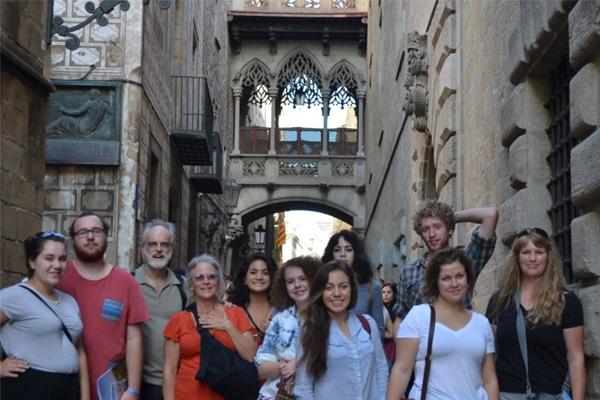
Students will explore and study the culture of their host country through a course taught by Barcelona SAE faculty. This course provides a broad overview of contemporary Spanish society by examining cultural traditions and values. In addition to topical lectures by native guest speakers, students will engage in experiential learning through field trips to historic and cultural sites. The course can fulfill both the Arts and Letters, and the Cultural Literacy requirement.
General Courses
To participate in the program, full-time enrollment (15-19 credits) is required. Students
must take 2 or 3 of the following classes taught by COCC faculty member, Sarah Fuller.
All three courses are transferable, with BI 142 and BI 202 as science discipline studies
courses and SUS 101 as a social science discipline studies course for the AAOT transfer
degree.
BI 142 : Introduction to Marine Biology
Examines the physical, chemical, and biological aspects of the marine environment
with emphasis on the ecology, biodiversity, sustainability, and conservation of marine
resources.
BI 202 : General Botany
Studies plant anatomy, human interactions with plants, and especially plant taxonomy
within an evolutionary framework. Focuses on flowering plant families common in the
region and identification using taxonomic keys.
SUS 101 : Introduction to Sustainability
Explores the environmental, social, and economic dimensions of sustainability. Defines and applies basic principles of sustainability to address today’s most pressing environmental and social challenges. Develops an understanding of how individual behaviors affect community and global health. Approaches sustainability from a multidisciplinary perspective by integrating faculty from across the curriculum, including public health, biology, natural resources, sociology, and economics.